Will Smith Travels the Earth, Pole to Pole
What you'll learn:
- How they filmed microscope science on a choppy ice-breaker.
- How they overcame cold weather’s effects on batteries.
- Why Will Smith is a fun adventurer.
I think the concept is perfect. Place a popular celebrity into a scientific crew and they get more attention to their cause and it’s a fun watch. It’s literally a fill-in-the-blank premise. Let’s see with some random picks:
- Paul Simon and Art Garfunkel cave- and water-diving, finding various geological samples while discovering harmony in the Earth’s crystals. Yes, I would watch every episode.
- Jenna Ortega painstakingly scans the Nile River with LiDAR to map its drift over time. A boring subject, but far more watchable.
- Hayao Miyazaki using a wingsuit to access archaeological sites otherwise unreachable. You better believe this is a family viewing night.
It works every time. No matter who and what.
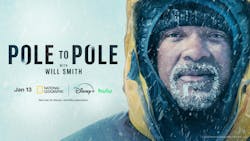
Here, Will Smith travels the planet with many different crews, from Earth’s top to bottom, literally from the South Pole to the North Pole. The show is about what it takes to capture the planet at its most unforgiving. It’s a personal journey for Will Smith, sure, but it’s also about the quiet heroism of crews and scientists. They do delicate work while the world around them shakes, freezes, and refuses to cooperate.
I’ve watched a lot of nature shows that scour the planet. It never stops amazing me how each crew handles the environment around them. They adapt. They prototype. They try again. It’s fun to watch and inspiring at the same time.
Getting Polar Bearings with Marine Life
The Arctic sequences are a great example. Polar ecologist Allison Fong’s research is a science story you rarely see unfold in real-time. Her work tracks phytoplankton, tiny organisms that sit near the base of the marine food web. The show leans into why they matter. They are a signal and a warning.
The discoveries here suggest these organisms can photosynthesize and hold onto energy longer than previously understood. That matters because sea ice is changing. Shifts in phytoplankton can help scientists anticipate what comes next. It’s a microscope-level finding. It has planet-scale implications. Boils down to this, without sunlight for months, how do these phytoplankton survive? Her answers and thoughts are worth the watch.
But the most memorable part is how they manage to film it.
Filming Micro-Organisms
Cinematographer Tom Williams describes it as one of the hardest tasks of the entire production. You are trying to record living micro-organisms. They don’t give you a second chance. The moment samples are collected, the clock starts ticking. Their lifespans are short. You have to capture what you need fast.
Now put that inside a lab on an icebreaker. The ship is smashing through sheet ice for hundreds of miles. Everything shakes. Filming at the microscopic scale requires stillness, though stillness barely exists here.
The crew’s solution is clever and practical. They set up a webcam on the bow of the ship and watched it from inside the lab. When they hit open water, they moved. Those were the rare moments when the ship wasn’t ramming ice. The microscopes were ready. The cameras were prepped. They recorded during short windows of relative calm.
It’s not movie magic, rather it’s timing and patience. It’s also creative problem-solving. That’s the show in miniature. The stakes are high. The fixes are often simple, yet the execution is hard. The series also lets the messy realities show. Many expedition-type shows make gear feel flawless. This one keeps the friction in frame. You see the near-misses and you hear about the failures. That honesty makes it feel more human.
Dealing with the Cold
In an interview, Williams also talks about testing gear for polar conditions in a London ice cream factory. A stand-in for extreme cold. The surprise weak point wasn’t a cinema camera. It was a “diary camera” setup. It was an iPhone running a dual-cam app for personal footage.
The problem was the cold. Batteries die fast in freezing conditions. I have the same problem with a mailbox camera in the cold, but that’s another story. So, the team engineered a custom 3D-printed housing that was meant to keep the phone warm. It worked too well — the phone overheated on first use.
Simple technology becomes complicated at the poles. It also shows how this series is shot. The show doesn’t rely on one camera style; it blends cinematic imagery with handheld diaries. It also uses specialist science capture, which must work under chaos.
The series is also built around real scientific missions; it’s not just scenic endurance. There’s a sense of collaboration — scientists and filmmakers plan together, and they still leave space for the unpredictable. In some cases, it seemed odd to leave what happened. I like the realism in that sense.
The show also respects the timeline of science. It acknowledges that findings need time after the expedition. Data requires processing. Conclusions need rigor. That choice keeps the storytelling grounded.
Celebrity Perspective
The celebrity-led structure can pull focus toward the emotional beat. Sometimes you want a few more seconds with the science. But Will Smith is an affable person. Hearing his thoughts and feelings about what’s happening is insightful into his celebrity mindset. Will Smith’s mentor said the answers to everything are at the edges of the world, to paraphrase. It’s fun to see how he discovers that in each episode.
In the end, Pole to Pole with Will Smith feels like a modern expedition story. It’s unique because it not only shows you the ends of the Earth, but also shows what it costs to film them and what it takes to truly see them. The show launched today, January 13, 2026, on Disney+/HULU.
Thinking back on where the series took me and how I think about the world, I feel just like Will Smith. “I’m even more curious now than when I began, and that is a beautiful thing.”
About the Author

Cabe Atwell
Technology Editor, Electronic Design
Cabe is a Technology Editor for Electronic Design.
Engineer, Machinist, Cartoonist, Maker, Writer. A graduate Electrical Engineer actively plying his expertise in the industry and at his company, Gunhead. When not designing/building, he creates a steady torrent of projects and content in the media world. Many of his projects and articles are online at element14 & SolidSmack, industry-focused work at EETimes & EDN, and offbeat articles at Make Magazine. Currently, you can find him hosting webinars and contributing to Electronic Design and Machine Design.
Cabe is an electrical engineer, design consultant and author with 25 years’ experience. His most recent book is “Essential 555 IC: Design, Configure, and Create Clever Circuits”
Cabe writes the Engineering on Friday blog on Electronic Design.
See Cabe's cartoons & comic strips here.
Voice Your Opinion!
To join the conversation, and become an exclusive member of Electronic Design, create an account today!

Leaders relevant to this article: