What’s The Difference Between High-Side And Low-Side Current Sensing?
The most common method for measuring currents in electronic circuits is to place low-value sense resistors in series with the load and measure the voltage drop across them. These voltage drops are very low, so their outputs are applied to precision instrumentation amplifiers with high input impedances. The high impedance minimizes loading on the sense resistor, and the instrumentation amplifiers are engineered to have a very linear transfer characteristic.
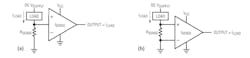
For what’s called low-side sensing, the sense resistor can be placed between the load and the common ground and used with a single-ended amplifier (Fig. 1a). Alternatively, the sense resistor can be placed between the load and the power supply, and a differential amplifier measures the current (Fig. 1b). This is the preferred configuration for several reasons.
The Trouble With Low-Side Sensing
One problem with low-side current measurements is that the current sense circuitry will not detect a fault if it shorts the top of the sense resistor to ground.
There is a more serious problem when low-side sensing is used to monitor multiple loads that can be switched on and off independently. In Figure 2, the current-sense resistors are labeled RS1 and RS2. The voltages at nodes VCOM1 and VCOM2 depend on the current flowing through those sense resistors. Therefore, the common voltage for loads 1 to 4 and loads 5 to 7 is potentially noisy. The difference can range from a few tens of millivolts to 1 V or even 2 V.
2. Monitoring multiple loads powered by a common supply strongly favors high-side sensing. The common-mode voltage is stable, and the potential for ground loops is reduced.
There are also potential ground loop problems. The voltage at VCOM2 could be higher or lower than the voltage at VCOM1, in which case current would flow between them, causing errors in the current measurements in RS1 and RS2.
Finally, parasitic resistance RP makes the ground-loop problem even more sinister. The voltages at VN1 and VN2 are negative with respect to VCOM1 and VCOM2. That means that, depending on its reference point, the amplifier used to buffer and amplify voltage across the sense resistor could see a negative common-mode voltage.
Appling high-side sensing, with a differential amplifier, to the multiple-load situation solves all those problems. The common nodes have a much smaller voltage difference between them and the low side of the voltage source, so potential ground loops are minimized (Fig. 2b).
A few special considerations must be taken into account when using high-side current measurement. For one, the precision amplifier across the sense resistors must be able to deal with the supply voltage as a common-mode voltage.
For another, measurement precision depends on matching the feedback and input resistors. To deal with this, amplifier manufacturers offer precision amps with internal laser-trimmed resistors.
A reader points out that Bob Pease had something to say about high-side sensing in a column on error budgets.
About the Author
 Don Tuite
Don Tuite
Don Tuite (retired) writes about Analog and Power issues for Electronic Design’s magazine and website. He has a BSEE and an M.S in Technical Communication, and has worked for companies in aerospace, broadcasting, test equipment, semiconductors, publishing, and media relations, focusing on developing insights that link technology, business, and communications. Don is also a ham radio operator (NR7X), private pilot, and motorcycle rider, and he’s not half bad on the 5-string banjo.
Comment About the Article
To join the conversation, and become an exclusive member of Electronic Design, create an account today!
 Leaders Logo
Leaders relevant to this article: